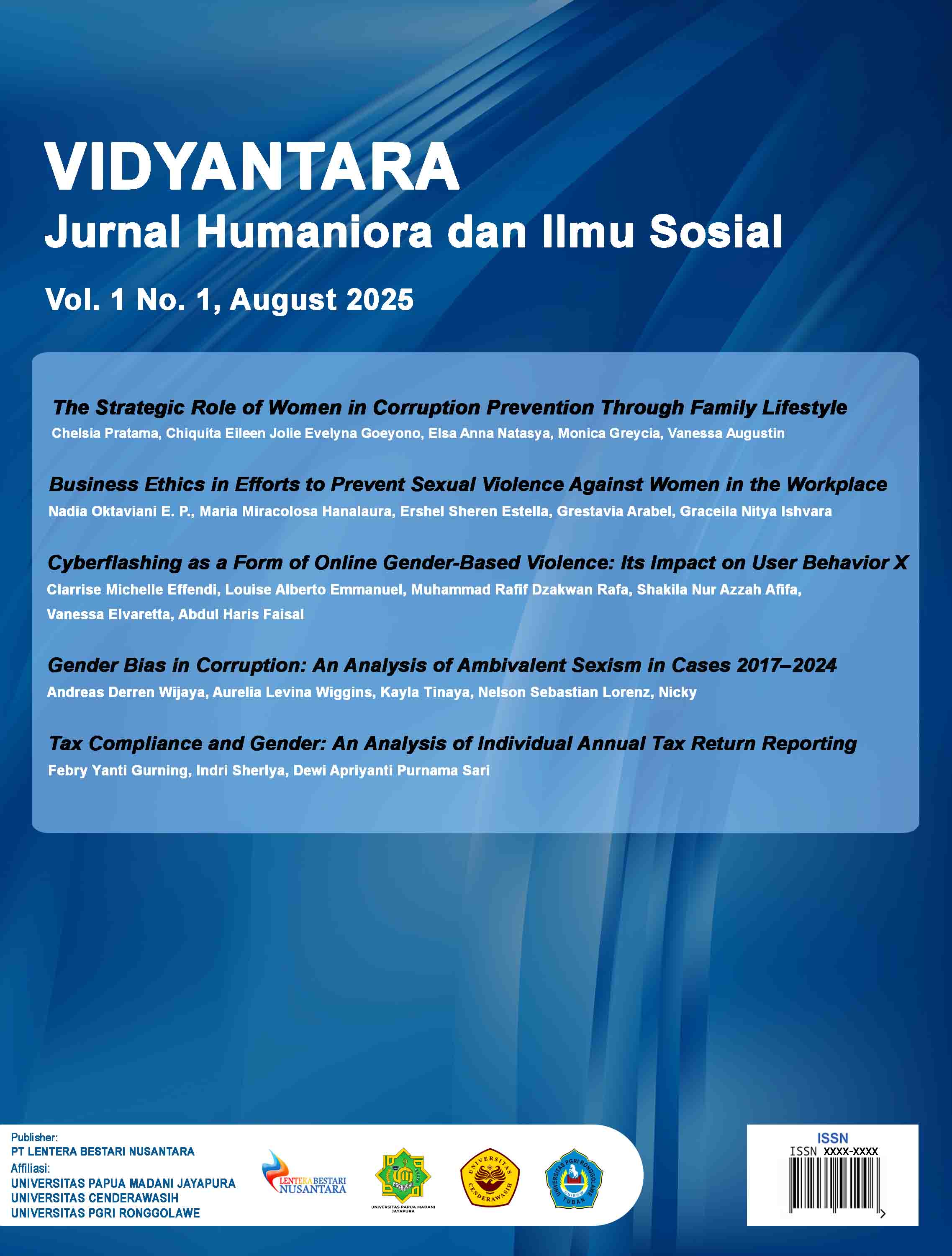
Cyberflashing as a Form of Online Gender-Based Violence: Its Impact on User Behavior X
Keywords:
Cyberflashing, Online Gender-Based Violence, X, Communication Privacy ManagementAbstract
This study examines the phenomenon of cyberflashing as a manifestation of Online Gender-Based Violence that is increasingly prevalent on Platform X (formerly Twitter), with a focus on differences in responses between male and female victims. The research methodology employs a qualitative-descriptive approach through data triangulation, including the distribution of questionnaires, social media content analysis, document studies, and in-depth interviews. The participants consist of 25 respondents, all of whom have experienced cyberflashing. The findings reveal that the majority of victims respond with defensive strategies, such as blocking perpetrators and adjusting account privacy settings. Additionally, significant psychological impacts were identified, including feelings of disgust, fear, and trauma. A comparative analysis indicates that female victims tend to exhibit more intense emotional reactions and take more proactive measures compared to male victims.
References
Athirah, S., & Hidayana, I. (2023). Women’s agency and resistance to cyberflashing on Twitter. Masyarakat: Jurnal Sosiologi, 28(1). https://doi.org/10.7454/mjs.v28i1.13562
Baizat, F., Rahma, Z., & Abusaid, S. (2022). The dark side of IT: The negative aspects of information technology. International Journal of Technology and Systems, 1(1). https://doi.org/10.47604/ijts.1709
Barker, K., & Jurasz, O. (2018). Online misogyny as a hate crime. https://doi.org/10.4324/9780429956805
Bowen, G. A. (2009). Document analysis as a qualitative research method. Qualitative Research Journal, 9(2), 27-40. https://doi.org/10.1108/19410870910953548
Brannen, Julia. (2005). Memadu Metode Penelitian: Kualitatif & Kuantitatif. Yogyakarta: Fakultas Tarbiyah IAIN Antasari Samarinda & Pustaka Pelajar.
Connell, R. W., & Messerschmidt, J. W. (2005). Hegemonic masculinity: Rethinking the concept.
Creswell, J. W. (2014). Research design: Qualitative, quantitative, and mixed methods approaches (4th ed.). SAGE Publications.
De Araújo, A., Bonfim, C., Bushatsky, M., & Furtado, B. (2022). Technology-facilitated sexual violence: A review of virtual violence against women. Research, Society and Development, 11(2). https://doi.org/10.33448/rsd-v11i2.25757
Donii, V. (2023). Specifics of the communication space of modern social media. Mìžnarodnij fìlologìčnij časopis, 14(3). https://doi.org/10.31548/philolog14(3).2023.09
Gender & Society, 19(6), 829–859. https://doi.org/10.1177/0891243205278639
H. Z. (2024). Women are less comfortable expressing opinions online than men and report heightened fears for safety: Surveying gender differences in experiences of online harms. arXiv (Cornell University). https://doi.org/10.48550/arxiv.2403.19037
Henry, N., & Powell, A. (2015). Beyond the ‘sext’: Technology-facilitated sexual violence and harassment against adult women. Australian & New Zealand Journal of Criminology, 48(1), 104–118. https://doi.org/10.1177/0004865814524218
Junior, K. G. (2021). Manajemen privasi komunikasi pengguna aplikasi kencan online “Tinder” di kalangan mahasiswa UNS. Jurnal Kommas. https://www.jurnalkommas.com/docs/Jurnal%20D0216052.pdf
Kamilah & Lestari (2020). Manajemen privasi pada pengguna media sosial Instagram. Fakultas Ilmu Sosial dan Ilmu Politik, Universitas Diponegoro. https://ejournal3.undip.ac.id
Kvale, S., & Brinkmann, S. (2009). Interviews: Learning the craft of qualitative research interviewing (2nd ed.). SAGE Publications.
McGlynn, C., & Johnson, K. (2021). Cyberflashing: Recognising harms, reforming laws. Bristol University Press. https://www.amazon.com/Cyberflashing-Recognising-Harms-Reforming-Laws/
Misoch, Sabina. 2014. Card Stories on Youtube: A New Frame for Online Self Disclosure. Media and Communication. Vol.2 No.1. 2-12.
Murthy, D. (2018). Social media research: An introduction. SAGE Publications.
Muryatini, N. (2024). Perlindungan terhadap Female korban kekerasan berbasis gender online dalam era digital. Jurnal Interpretasi Hukum, 5(2), 969–976. https://doi.org/10.22225/juinhum.5.2.10396.969-976
Petronio, S. (2000). The boundaries of privacy: Praxis of everyday life (1st. Balan). Lawrence Erlbaum Associates Publishers.
Petronio, S. (2002). Boundaries of Privacy:Dialectic of Disclosure
Petronio, S. (2012). Blogging privacy rule orientations, privacy management, and content deletion practices: The variability of online privacy management activity at different stages of social media use. Computers in Human Behavior, 28(5), 1859–1872. https://doi.org/10.1016/j.chb.2012.05.004
Rossettini, S. (2025). Breaking the web of abuse: The realm of technology-facilitated gender-based violence. European Student Think Tank.
Safenet. (2022, August). Analisis pelanggaran hak-hak digital triwulan II 2022.
Safenet. (2023, April). Laporan pemantauan hak-hak digital triwulan I 2023.
Safenet. (2023, August). Laporan pemantauan hak-hak digital triwulan II 2023.
Salsabila, N. A. (2023). Cyberflashing dan hukum pidana di Indonesia. Jurnal Ilmu Hukum, 8(2), 1–10.
Stevens, F., Enock, F. E., Sippy, T., Bright, J., Cross, M., Johansson, P., Wajcman, J., & Margetts,
Sudirman, F. A., & Susilawaty, F. T. (2022). Kesetaraan gender dalam tujuan pembangunan berkelanjutan (SDGs): Suatu reviu literatur sistematis. Journal Publicuho, 5(4), 995–1010. https://doi.org/10.35817/publicuho.v5i4.41
Sugiyono. (2010). Metode penelitian kuantitatif, kualitatif dan R & D. CV Alfabeta.
Syahda, A., & Ramaiah, A. (2024). Sexual violence in virtual world: The unaddressed legal protection issue for victims. Neoclassical Legal Review: Journal of Law and Contemporary Issues, 2(2). https://doi.org/10.32734/nlr.v2i2.14057
Downloads
Published
Issue
Section
License

This work is licensed under a Creative Commons Attribution-NonCommercial 4.0 International License.
 Focus & Scope
 Editorial Team
 Reviewer Team
 Author Guidelines
 Article Template
 Author Fee
 Publication Ethics
 Plagiarism Policy
 Open Access Policy
 Peer Review Process
 Copyright and License
 Submission
 Archiving & Repository
 Contact